Safari planning
Safari Day Trip From Diani Beach vs Overnight Safari: Which Is Better?
A day trip to Tsavo is possible but demanding; an overnight safari changes everything. How to choose the right format for your Diani Beach holiday.
By Bernd Trompell · · 10 min read
You are settled into Diani Beach, the Indian Ocean is outside your door, and now the question arrives: can you fit a real safari into a beach holiday without it taking over the trip? The honest answer is yes — but the version you choose matters enormously. A day trip and an overnight safari are different products with different rewards, and picking the wrong one for your group is the most common planning mistake on Kenya's south coast.
This guide compares the two options specifically from a Diani Beach base. It covers what a day trip realistically involves, which parks suit which format, what an overnight stay adds, and how costs, seasons and family needs change the equation. It is a planning guide, not a bookable package: confirm routes, fees and availability for your own dates before paying anyone.
The Short Answer
Yes, a safari day trip from Diani Beach is realistic — Shimba Hills is the easy option and Tsavo East is possible as a long, demanding day. But if wildlife is a priority rather than a checkbox, an overnight safari is usually better: you gain the early-morning and late-afternoon game drives when animals are most active, and you stop spending most of your day in a vehicle. Tsavo West and Amboseli should not be attempted as day trips at all.
Can You Realistically Do a Safari Day Trip From Diani Beach?
Yes, with honest expectations. Diani Beach sits on Kenya's south coast, and the nearest serious wildlife destinations are inland. A day trip means an early departure — operators typically collect guests around 5:00 — several hours of road travel, a game drive of a few hours, and a return to the coast in the early evening. Operators describe Tsavo East day trips as thirteen-to-fourteen-hour days. That is a real safari experience, but it is also a long, tiring day in which driving outweighs wildlife viewing.
The alternative is a safari with one or more nights in or near the park. You travel at a more humane pace, sleep to the sounds of the bush, and — crucially — you are out on game drives at dawn and dusk, when many animals are most active and the light is at its best. The trade-off is time and money: an overnight safari consumes at least two days of your holiday and adds accommodation cost.
Neither choice is universally right. A day trip suits travellers with limited days who want a taste of safari without rearranging their beach holiday. An overnight safari suits travellers for whom wildlife is a headline reason for coming to Kenya. The sections below help you decide which description fits you.
Day Trip, Full-Day Game Drive or Overnight Safari: What's the Difference?
Terminology causes real confusion when comparing offers. A wildlife day trip from Diani usually means a return journey in a single day: you sleep in your coastal accommodation before and after. Within that, a full-day game drive format maximises hours inside one park, while shorter excursions — such as Shimba Hills — combine a morning or afternoon of wildlife with other stops.
An overnight safari adds at least one night in a lodge or tented camp inside or beside the park. This changes the rhythm completely: instead of one midday game drive squeezed between two long road legs, you get an afternoon drive, a night in the bush, and an early-morning drive before returning. Two-night and three-night safaris extend this further and can combine two parks, such as Tsavo East and Tsavo West.
When comparing quotes, check which format is actually being sold. A 'two-day safari' means one overnight; a 'one-day safari' means none. Ask exactly how many hours are planned inside the park, because that number — not the tour's name — tells you what you are buying.
Shimba Hills: The Shorter Excursion Option
Shimba Hills National Reserve is the closest wildlife area to Diani Beach: roughly 36 kilometres inland, about 45 to 60 minutes by road. The Kenya Wildlife Service calls it the 'Paradise of the Sable Antelope' — it protects Kenya's last breeding herd of this rare antelope — and the reserve's coastal forest, rolling hills and the Sheldrick Falls make it a genuinely pleasant half-day or full-day outing.
Be candid with yourself about what Shimba Hills is not. It is a small forested reserve, not a savanna park, and the density and variety of large animals is far lower than in Tsavo. You may see sable antelope, elephants, giraffes and abundant birdlife — or you may have a quiet day, because wildlife sightings are never guaranteed anywhere. If your dream is the classic East African game drive with big herds across open plains, Shimba Hills will not deliver it.
Where Shimba Hills excels is as a low-commitment taste of the bush: no 5:00 start, no exhausting drive, and you are back at the beach by afternoon. For families with young children, travellers unsure whether they enjoy game drives, or anyone with a single spare morning, it is the sensible first step. Check current access conditions before visiting — the walk to Sheldrick Falls, for example, may require a ranger escort.
Tsavo East as a Day Trip: Possible but Demanding
Tsavo East is one of Kenya's largest national parks and the classic safari destination from the coast. The Kenya Wildlife Service highlights its famous red-dust elephants — coloured by the region's red soil — and the Galana River, which draws wildlife in dry periods. Operators typically quote around 210 kilometres and three-and-a-half to four hours from Diani, often entering via Bachuma Gate, though the right gate depends on which part of the park you will visit.
A typical day trip runs on a tight schedule: pickup around 5:00, arrival at the gate around 7:30, game drives through the morning, lunch, a further drive, and return to Diani in the early evening. That leaves perhaps four to five hours of actual game viewing inside a thirteen-to-fourteen-hour day. Traffic, road conditions and gate formalities can compress this further. It is doable and many travellers enjoy it — but go in knowing it is an endurance day, not a relaxed one.
A day trip to Tsavo East makes most sense if you have exactly one day available and accept the trade-offs. If you can free a second day, the same park becomes dramatically better with an overnight: you arrive without rushing, take an afternoon game drive, sleep inside or beside the park, and are out again at dawn — the two best wildlife-viewing windows, both of which a day trip largely misses. For a longer option, our related safari brand Fernweh Safaris outlines a four-day Tsavo-area safari from the coast, booked directly with them.
Why Tsavo West Deserves More Time
Tsavo West is the more varied and scenic of the two Tsavo parks: volcanic hills, lava flows, and the famous Mzima Springs, where crystal-clear water emerges from lava rock and supports hippos and crocodiles, viewable — according to the Kenya Wildlife Service — from an underwater observation chamber. It is a rewarding park, but it is not a coast day trip.
The Kenya Wildlife Service quotes about 250 kilometres from Mombasa to Mtito Andei Gate, and from Diani you must add the coastal leg. No officially confirmed Diani-to-gate drive time exists, so treat any quoted figure as an estimate and plan for several hours — longer than the run to Tsavo East. The park's denser vegetation also means wildlife viewing takes more patience than in Tsavo East's open country.
For these reasons, Tsavo West is best done with at least one overnight, and it shines most as part of a two- or three-day safari combining both Tsavo parks. If an operator offers you Tsavo West as a day trip from Diani, ask hard questions about how many hours you would actually spend inside the park.
Amboseli: A Longer Safari, Not a Day Excursion
Amboseli National Park is one of Africa's most celebrated wildlife destinations: the Kenya Wildlife Service calls it the 'Home of the African Elephant', and its great herds against the backdrop of Mount Kilimanjaro — when the mountain emerges from cloud, which is not guaranteed — produce some of safari's most famous images.
From Diani Beach, however, Amboseli is roughly 520 kilometres away, with a reference drive time of seven to eight hours each way. As a day trip it is simply not viable: you would spend fourteen to sixteen hours driving for no meaningful time in the park. Even as an overnight trip it is rushed. Amboseli deserves two to three nights and works best as a distinct leg of a longer itinerary — for example combined with a Nairobi arrival, as our Kenya safari and Diani Beach holiday guide explains.
If Amboseli is a bucket-list priority, plan your holiday around it rather than squeezing it into a beach week. If your heart is set on staying put in Diani, Tsavo is your park.
Day Trip vs Overnight Safari at a Glance
The table below compares the realistic options from a Diani Beach base. Drive times are estimates from operator and reference sources, not guaranteed journey times — confirm routing for your specific date, gate and lodge. Wildlife-viewing assessments describe typical park strengths, never guaranteed sightings.
| Option | Travel effort | Wildlife-viewing time | Overnight required | Best suited to |
|---|---|---|---|---|
| Shimba Hills | 45–60 min each way (approx. 36 km) | Half-day to full-day outing | Not needed | Families, first-timers, a spare morning |
| Tsavo East day trip | 3.5–4 h each way (approx. 210 km; operator estimate) | 4–5 h game viewing in a 13–14 h day | Not needed | Travellers with exactly one free day |
| Tsavo East overnight | 3.5–4 h each way, spread over two days | Afternoon + dawn game drives | 1 night in/near the park | Wildlife-focused travellers, photographers |
| Tsavo East + West | Two park legs over three days | Multiple drives across both parks | 2 nights | Travellers wanting depth and Mzima Springs |
| Amboseli | 7–8 h each way (approx. 520 km; reference estimate) | Full safari days, possible Kilimanjaro views | 2–3 nights | A dedicated leg of a longer itinerary |
Sample One-, Two- and Three-Day Safari Plans
These sample structures show what each format realistically contains. They are planning illustrations, not bookable packages, and assume a Diani Beach start and finish. Times shift with road conditions, gate choice and your operator's schedule.
The one-day plan shows how much of the day is transport. The two-day plan is the point at which a Tsavo East safari becomes genuinely rewarding. The three-day plan adds Tsavo West and the Mzima Springs, and is the shortest format that does justice to both parks.
One-day plan: Tsavo East day trip
| Time / day | Plan |
|---|---|
| 05:00 | Pickup in Diani Beach; drive inland |
| 07:30 | Arrive at the park gate; formalities |
| 08:00–12:30 | Morning game drive |
| 12:30–13:30 | Lunch break |
| 13:30–15:30 | Afternoon game drive |
| 15:30 | Depart the park |
| 18:00–19:00 | Return to Diani Beach |
Two-day plan: Tsavo East with one overnight
| Time / day | Plan |
|---|---|
| Day 1 morning | Depart Diani after an early breakfast; drive to Tsavo East |
| Day 1 midday | Arrive, check in, lunch |
| Day 1 afternoon | Afternoon game drive |
| Day 1 evening | Dinner and overnight in/near the park |
| Day 2 early | Dawn game drive — the best viewing window |
| Day 2 late morning | Breakfast, depart, return to Diani by afternoon |
Three-day plan: Tsavo East and Tsavo West
| Time / day | Plan |
|---|---|
| Day 1 | Drive to Tsavo East; afternoon game drive; overnight |
| Day 2 | Dawn drive in Tsavo East; transfer to Tsavo West; afternoon drive; overnight |
| Day 3 | Morning visit to Mzima Springs and final drive; return to Diani by evening |
What an Overnight Safari Actually Adds
The case for overnighting rests on animal behaviour. Many species are most active in the cool hours after dawn and before dusk, resting through the midday heat — exactly when a day tripper is in the park. An overnight safari puts you on the track at first light, when predators may still be active and the low sun makes for extraordinary light, and again in the late afternoon as the bush wakes up again.
There is also the experience itself: dinner under stars, the sounds of the bush at night, and waking up already inside the park rather than facing a four-hour drive. Lodges and tented camps range from simple to luxurious, and many include meals in their rates.
Finally, an overnight safari is simply less rushed. You stop watching the clock, your guide can linger at sightings, and a delay on the road does not erase your game drive. For photographers, wildlife enthusiasts and anyone celebrating a once-in-a-trip occasion, the extra night is usually the best money in the budget.
Cost Considerations: Fees, Transport, Vehicle and Accommodation
A safari's total cost combines several blocks: park entry fees, the vehicle with driver-guide, fuel, meals, and — for overnight trips — lodge or camp accommodation. Reputable operators itemise what is included; compare only complete quotes, never headline prices alone.
Park entry fees are set by the Kenya Wildlife Service. The table below shows the published KWS rates for non-residents per person per day, from the official tariff dated October 2025 and checked on 5 November 2026. KWS defines children as aged 5 to under 18. Fees can change — verify the current tariff before you travel, as no newer official 2026 tariff was available at the time of checking.
Beyond entry fees, the vehicle and guide are usually the largest cost and are typically charged per vehicle per day — so per-person costs fall as your group grows. Lodge prices vary enormously by standard and season, and meals are often but not always included. We deliberately publish no package prices: they depend on season, group size, accommodation and operator, and change regularly. Obtain several written, itemised quotes. Our Diani Beach holiday cost guide helps you fit a safari into your overall budget.
| Park / reserve | Adult (non-resident, per day) | Child 5–17 (per day) |
|---|---|---|
| Tsavo East / Tsavo West | $80 | $40 |
| Amboseli | $90 | $45 |
| Shimba Hills | $20 | $10 |
| Kisite-Mpunguti (marine) | $25 | $15 |
Safari Planning for Families and Larger Groups
With children, the format question becomes sharper. A Tsavo East day trip means a pre-dawn wake-up, many hours in a vehicle, and no leaving the car during game drives — a genuine strain for young children, though school-age children with an interest in animals often manage well and remember the day for years. Shimba Hills is the gentler introduction, and an overnight safari with a lodge pool and an unhurried pace often works better than a marathon day.
Ask operators specifically about child seats or boosters, planned toilet and rest stops, vehicle occupancy, and any age rules at lodges — we could not confirm a universal minimum age for safaris, and policies vary by operator and property. A private vehicle gives your family freedom to stop and turn back; a shared group tour does not.
Larger groups should coordinate more than bed counts: vehicle seating, luggage space, room-sharing and budget expectations all need agreement before one person pays a deposit. Our guides to Diani Beach with kids and planning a large family holiday cover the coastal side of these questions.
Seasons, Packing and Practical Booking Advice
Safaris from the coast run year-round, but conditions differ. In the dry seasons, animals concentrate around water and vegetation is thinner, making viewing easier — many travellers favour January to March and June to October. In the rainy seasons (the Kenya Meteorological Department defines March to May as the long rains and October to December as the short rains), the landscape is greener and lusher, but unparked park tracks can become difficult and wildlife disperses. Check fresh forecasts and current road conditions rather than relying on the calendar alone; our best time to visit Diani Beach guide covers the coastal side.
Pack for a long day in a vehicle and shifting temperatures: neutral light clothing with a layer for the early morning, a hat, sunglasses, high-factor sunscreen, binoculars, a camera with charged batteries, a refillable water bottle, personal medication, and your travel documents for park entry. Soft bags rather than hard suitcases make loading easier on multi-day trips.
When booking, get the offer in writing and confirm: pickup time and point, expected return, vehicle type and seat count, guide language, included meals and drinks, whether park fees are included or paid separately, cancellation terms, and the procedure for bad weather or vehicle trouble. Be cautious of prices far below all competitors or operators who will not provide a written breakdown. Payment should be documented, with the balance and currency agreed in advance.
Zavani: Your Private Villa Base Between Beach and Bush
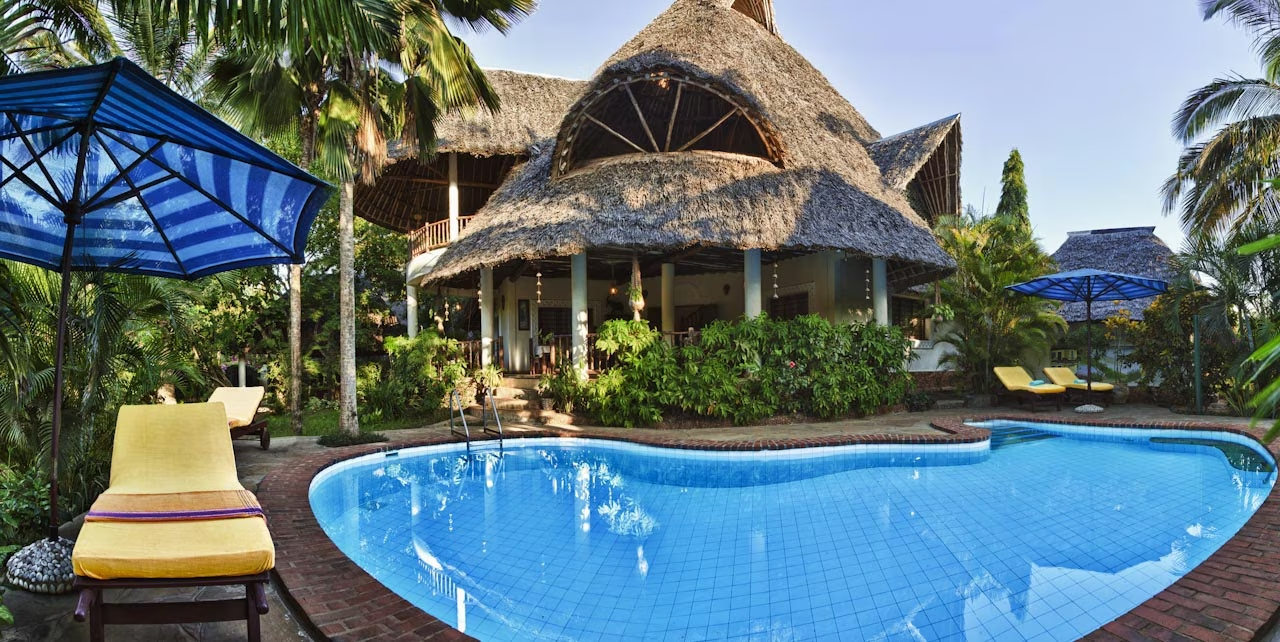
Zavani is a private holiday villa approximately 300 metres from Diani Beach — near the beach, not beachfront. It sleeps up to 12 guests across six bedrooms in two three-bedroom units: the main house and the guest cottage. Chef services and daily housekeeping are included, while groceries are charged separately. For families and groups combining beach days with a safari, the villa offers something a hotel cannot: your own space to return to, on your own schedule.
To be clear about roles: Zavani does not operate safaris, provide safari transport or include excursions. Safaris are booked with independent operators whose services you assess and agree yourself. What Zavani provides is the base — space for the whole group, flexible meals, and the possibility of an early breakfast before a 5:00 safari pickup if you arrange it with the team.
When you enquire, mention your dates, group size and whether you plan a safari, so your stay can be shaped around your excursion days. Explore the villa for details, or enquire about your stay directly.
Frequently Asked Questions
Can you do a safari day trip from Diani Beach?
Yes. Shimba Hills is an easy half- or full-day excursion about 45–60 minutes away, and Tsavo East is possible as a long day trip with a pickup around 5:00 and return in the early evening — roughly a thirteen-to-fourteen-hour day. Tsavo West and Amboseli are not realistic as day trips.
Is a Tsavo East day trip worth it?
It depends on your priorities. You will typically get four to five hours of game viewing within a very long day of driving. If you have only one free day and want to experience a major national park, it can be worthwhile. If wildlife is a highlight of your trip, an overnight safari is markedly better value in experience per hour.
What does an overnight safari add compared with a day trip?
The two best game-viewing windows — early morning and late afternoon — plus a night in the bush, an unhurried pace, and resilience against road delays. You trade one to two days of beach time and the cost of lodge accommodation.
How long is the drive from Diani Beach to Tsavo East?
Operators typically quote around 210 kilometres and three-and-a-half to four hours, often via Bachuma Gate. Treat this as an estimate: traffic, road conditions and your specific gate and route can extend it. Confirm the plan with your operator for your date.
Can you visit Amboseli from Diani Beach?
Not as a day trip — Amboseli is roughly 520 kilometres away, about seven to eight hours' drive each way. It deserves two to three nights and works best as a separate leg of a longer itinerary, for example combined with a Nairobi arrival.
Are wildlife sightings guaranteed on a safari?
No. Wild animals move freely, and no reputable operator guarantees specific sightings. Tsavo East is known for its red-dust elephants and offers good chances of seeing many species, but every game drive is different — that uncertainty is part of safari.
What do park entry fees cost?
Per the KWS tariff of October 2025 (checked 5 November 2026), non-residents pay per day: Tsavo East and West $80 per adult and $40 per child, Amboseli $90/$45, Shimba Hills $20/$10, Kisite-Mpunguti Marine Park $25/$15. Children are aged 5 to under 18. Fees can change — check the current KWS tariff before travelling.
Is a safari day trip suitable for young children?
A full Tsavo East day trip is demanding for young children: a pre-dawn start, many hours in a vehicle and no leaving the car during game drives. Shimba Hills is the gentler option, and an overnight safari at a relaxed lodge often suits families better than a marathon day. Confirm child seats, rest stops and lodge age policies with your operator before booking.
Sources and Planning References
- Kenya Wildlife Service: conservation fees, October 2025
- Kenya Wildlife Service: Tsavo East National Park
- Kenya Wildlife Service: Tsavo West National Park
- Kenya Wildlife Service: Shimba Hills National Reserve
- Kenya Wildlife Service: Amboseli National Park
- Kenya Wildlife Service: Kisite-Mpunguti Marine Park
- Kenya Wildlife Service: protected-area rules (park hours)
- Kenya Meteorological Department: seasonal climate patterns
Checked 5 November 2026. Park fees follow the official KWS tariff of October 2025 and can change; drive times are operator and reference estimates, not guaranteed journey times; park hours come from the KWS protected-area rules document and should be confirmed before travel. Wildlife sightings are never guaranteed. This guide does not sell safari packages.
More stories from the coast
Comparing coastal destinations too? Read our Diani Beach vs Watamu guide, or our German-language comparison of safari options from Diani Beach.